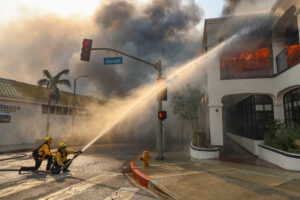
As wildfires persistently threaten communities across California and the western United States, a surge of novel wildfire defense products has entered the market. These range from rooftop sprinkler systems and ember-resistant coatings to portable pool pumps and fire-blocking gels, with homeowners being flooded with assurances of safety and protection.
At first glance, these products may seem to provide assurance. They assert to be “firefighter trusted,” “wildfire proven,” or “approved for use in fire zones.” However, what do these claims substantively signify? In numerous instances, little to no meaningful truth.
The Challenge: An Overwhelming Marketplace
The wildfire defense market has grown quickly, often exceeding standards, regulations, and verified testing. Homeowners eager to protect their families and properties are confronted with persuasive marketing, emotional appeals, and urgent messages. Meanwhile, Fire Safe Councils, local agencies, and community groups are doing their best to offer accurate and unbiased guidance. However, the large variety and complexity of available products make it increasingly challenging.
The main issue? Many of these tools and systems lack transparent third-party validation. Despite the confident marketing language, few have:
- Published lab-tested performance data
- Independent field trials over extended periods
- Certification from established standards organizations
- Compliance with critical codes like NFPA 1144, UL 2396, ASTM E108, or ASTM E84
Without these assurances, the effectiveness of such products—especially in actual wildfire situations—remains uncertain at best.
Accountability Over Alarm
At MySafe:LA, we strongly believe in promoting preparedness but also emphasize accountability. Our message is clear: before investing in a wildfire protection product, ask the right questions.
• Is there transparent, published testing data?
• Does the product comply with established national or international standards?
• Is there oversight from recognized agencies, laboratories, or regulatory bodies?
• Are the marketing claims independently verified, or just promotional slogans?
Preparedness should never be driven by fear alone. Emotional decisions made after devastating wildfires can lead to misplaced trust—and wasted money. Instead, choices should be based on clarity, research, and data.
Firefighter Trusted? Show Us the Proof.
Claims like “used by firefighters” or “first responder approved” are often meant to instill confidence. However, these phrases are seldom backed by official documentation. Firefighters and public safety agencies usually do not officially endorse commercial products unless they have gone through a formal review process, and even when they do, such endorsements are rarely made public.
We strongly encourage manufacturers to undertake the publication of independent testing results. Additionally, we advocate for governmental bodies to expedite efforts aimed at standardizing product claims and labeling.
How You Can Protect Yourself—Smartly
- Do Your Research
Consult Fire Safe Councils, wildfire prevention organizations, and local fire departments. Look for impartial reviews and performance comparisons—not just sales literature.
- Understand the Standards
Learn what standards like NFPA 1144 (Standard for Reducing Structure Ignition Hazards from Wildland Fire) or ASTM E108 (fire testing of roofing systems) actually measure.
- Ask for Documentation
Any product worth your investment should be able to provide proof of lab testing, compliance reports, or certification from a credible third party.
- Think Long-Term
Will this product hold up after five or ten years? Can it survive the intense heat, smoke, wind, and debris of an actual wildfire? If it needs power or water, can it function if utilities are down?
Preparedness is Empowerment—Not Panic
At MySafe:LA, we stay dedicated to giving residents practical, evidence-based ways to lower wildfire risk. Innovation is good—but it must be carefully examined. Not every product lives up to its claims, and protecting your home shouldn’t depend on who has the most convincing brochure.
If you’re looking into new wildfire defense tools, we encourage you to contact us or visit trusted sources like CAL FIRE, the NFPA, or your local Fire Safe Council.
Stay informed. Ask questions. And protect your home with facts, not fear.